
Hyde Manor
Updated: May 6, 2021
This is adapted from a talk I gave at the Sudbury meeting house.
I was asked because our resident Hyde Manor historian, Steve Sgorbati,
was unavailable. Because he wasn't present, I felt comfortable lifting a
lot of his work. But he didn't know about the old black cooks stuffing me with desserts.
That's all me.
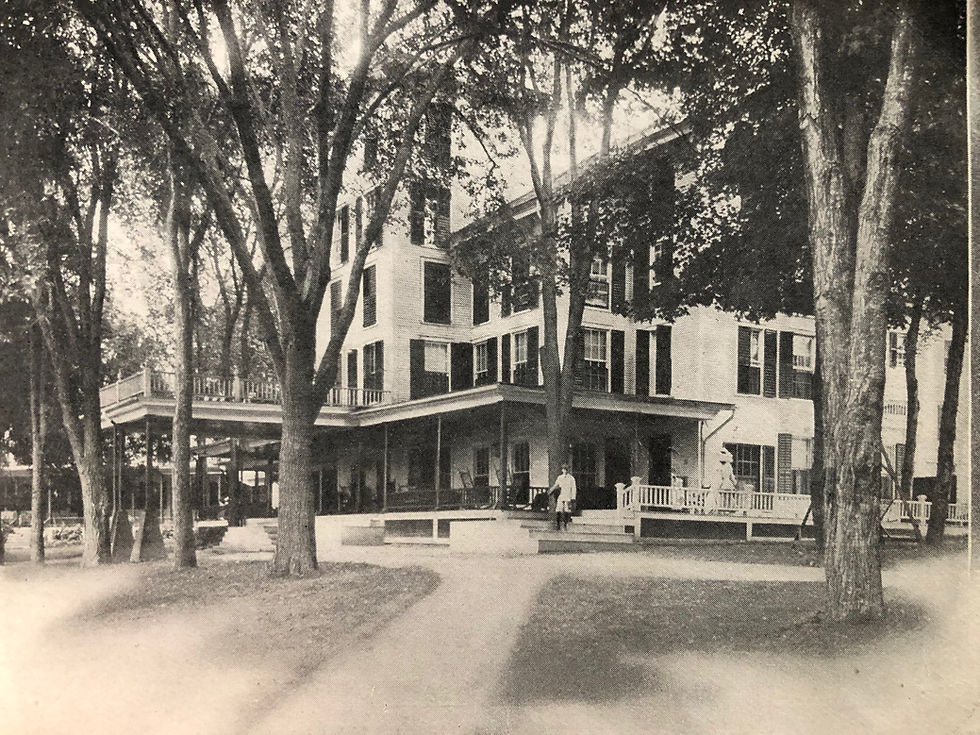
I’ve been connected with “the Manor” one way or another most of my life. The first time I was ever in the hotel itself, I was probably only five years old. In the late 1950’s, my mom was Kibby’s secretary. He was James Kilbourne Hyde Jr., but everybody called him Kibby. Of course I was very young, and I don’t remember him well, but I know he was widely liked and respected. Part of the attraction of the job for my mom was built-in childcare. While she took dictation, we would be fussed over and fed desserts back in the kitchen by my Aunt Helen Tupper and the other kitchen help, who were a handful of mostly old, mostly black people. Kibby ran a hotel in St. Augustine Florida called the Ponce de Leon, so he and his crew, most of whom had been with him for years and years, spent the winter there and the summer here. I think the hotel had been in the red for years, and I think Kibby was hanging on for these loyal employees, for his loyal clientele, which had dwindled to a handful of mostly old ladies rocking on the porch all summer, and to not disappoint his father, James K. Hyde.
James died in 1960 and Kibby didn’t open the doors in 61, then sold in 1962.
He was the fifth generation, and every generation before had been able to make the changes needed to keep the place growing and prosperous. But the day came when, with improved roads and cars, and Holiday Inns, vacations changed. But the old Hyde Manor did not, probably could not, change. In those fading years of the hotel, he only did what he had to to keep the place going, and every year they slapped another coat of gray paint on about everything, whether it was rotting or not, which led to an expression some people used around here. When someone came to him reporting something broken and hanging, he would say “paint it gray and let it hang.” So if you were doing a quick fix on something, someone would be apt to say, “Kibby says paint it gray and let it hang.” Consequently, when he closed the doors in 1961, everything was still there, but worn and threadbare. When I could, I would escape the old ladies in the kitchen and wander around the old place and it was grand and fascinating. The dining room could seat 200 people and was floor-to-ceiling windows on three sides that looked out on elaborate flower gardens with odd statuary, and winding stone paths that led to secluded benches under giant maples and elms. There was a round pool with a life-size cast swan, and a little waterfall with a bridge leading to the bowling alley and billiard room. Everything was there for a grand leisurely summer. Everything except the people. Maybe one way to understand what went wrong is to look at how they got there.
Samuel Mills built a stage stop there in 1798. Pitt Hyde had a Stageline serving Montréal, Burlington, Albany and points in between. He had six- and eight-horse coaches and advertised Burlington to Albany in 24 hours. This road through Sudbury was the main route, but it was still pretty rough. One passenger talked about the mud being up to the horses’ bellies. Mills Tavern was one of his favorite stops, so he bought it in 1801. He was from up north and Hyde Park was named for his family. He had brothers that became magnates in Castleton, and the village of Hydeville is named for them. He built a new hotel after a few years, but that one burned in 1862. By then, his son James had taken over and he built the one that is there today. It was grand and it could accommodate 150 guests. James was very successful and handed over the management of the new hotel to his 23-year-old son, Arunah Waterman Hyde. Not surprisingly, they called him A.W.
Meanwhile, James went on a world tour and is said to be one of the company that Mark Twain traveled with, then wrote about in his book, “The Innocents Abroad.” Up to this point, a lot of their success was due to city people coming up to “take the waters.” Mineral springs were all the rage, and Hyde’s hotel had one just loaded with iron and sulfur and available, bottled for your convenience.
A.W. really went on a building spree. Water was starting to be passé, so he started building and adding on all the latest improvements and entertainments. They already owned 450 acres, going all the way up to Huff Pond and to the top of Breakneck Hill. Somewhere in there, he bought most of the land around Hinkum Pond and built a camp for guests. They bought the lot on Hortonia and built the boat house. They bought what we always called Col. Moore’s Island and built a camp there. They built the first annex, which boosted capacity to 200. They built the cottages that are still there, north of the hotel. Kibby kept the cottages and the family still owns them.
Now we are up to the 1890’s and it’s A.W. and Son, which would be James, Kibby’s dad. The place is jumping, so when the first annex burned in 1891, they built a new one as big as the hotel, so now they could accommodate 300. They built the casino, which had a dance floor and stage and bar. They built the recreation hall, which had two bowling lanes and billiard tables. They connected the hotel and annex and cottages with a wide 300-foot-long covered porch. They built the first golf course in the 1890’s. Nine holes up behind the hotel. If you’ve ever been up there, you would wonder how could there possibly have been a golf course there. But I can show you a perfectly square, perfectly flat spot of ground on a hillside up there that was obviously a tee. It has a pine tree about two feet in diameter growing on it. Apparently, the guests thought it was too difficult too, and that’s why they built the new one across the road. That one was designed by Horace Rollins, who won the first U.S. Open in 1895. Construction was directed by George Sergeant, who won the U.S. Open in 1909, registered under the Hyde Manor Golf Club. Somewhere in there they acquired a hotel in New York City called the Iroquois.
It’s probably hard to overstate what the Hyde Manor meant to the economy of Sudbury. Imagine if we had a business in town that employed that many people, and bought virtually all of its provisions locally. Tom and John Williams’ father, Therron, told me that anytime you needed a dollar, Hydes would buy wood and pay $1 a cord. My great grandfather Clyde’s journals frequently had entries like “load of hay to Hyde’s, 2150 pounds.” And this, at a time when people did a lot of barter because cash was really hard to come by.
The Manor must have had great cultural significance, too. At one time, they boasted that the Cecelia Orchestra from Boston provided music mornings and evenings. Janet Zutell’s dad, Grant Griffin, one of Sudbury’s all-time great story tellers, by the way, told me about Mr. Duesenberg showing off his latest model. He put a glass of champagne on the hood to show how smoothly it ran. Incidentally, Henry Ford spend at least one week there.
By this time, their clients were usually families, mostly from Albany and New York, and many of them had been coming for generations. The hotel had a specially built 16-passenger coach pulled by four horses that met them at the trains, which stopped at Brandon and Castleton. They brought trunks full of clothes and a great many of them stayed for the whole summer. They had their own society at the Manor, and traditions like the annual picnic and the weekly Quoit tournament. Don’t ask me what Quoit is - I have no idea.
They had weekly reports written in the New York Times about what was going on. This is part of one from the August 21, 1909 New York Times. “Much curiosity had been aroused by the announcement that Japanese maidens would serve tea on the veranda and there was great applause when H.B. VanDerveer, W.S. Brewster, T.C. Havens, and J.K. Hyde appeared dressed in pale blue kimonos and sashes and fancy headgear.”
Automobile arrivals included Mr. and Mrs. Daniel F. Kellogg of New York; Mr. and Mrs. Datershaul , Amsterdam; Mr. and Mrs. H. J. Dean, Detroit,” et cetera. There were about eight new arrivals in cars in one week in 1909. I was surprised at that. I was a little surprised that James K. Hyde, distinguished host, was serving tea in drag. But I think it shows how there was this society there that was very tight and having a lot of fun.
At this time, the automobile was a novelty and welcome, but eventually, it was the auto as much as anything that did them in. People didn’t want to stay in the same place all summer anymore, and they didn’t want grand old stuff. They wanted snappy new stuff.
The big annex burned in 1944. It was a huge event. The annex was as big as the main hotel and only a few feet away, connected by wooden porches. James Hyde saw the flames out the window of his cottage and told the phone operator to put out the word. Over 100 volunteers showed up and had bucket brigades going before the fire departments even got there. All the effort went to soaking down the cottages and the hotel to try to save them, and to removing valuable items from the hotel and the Hydes’ cottage.
We have a couple of porcelain figurines that were given to my grandmother for all their help that night and in the days that followed. I guess we transported and stored a lot of their belongings to get them out of the weather until they were able to move back in. They built yet another annex, but much smaller. Kibby took over and began to divest. They sold the Hinkum property and Colonel Moore’s Island. They tore down the horse barn across the road that had been built to house 200 horses. Finally, in 1962, he sold out to Eddie Dhlos and family. He kept the cottages for his family and he gave his long-time caretaker, Al Greeley, a life lease to the house he and his family lived in. That would be the house now abandoned north of the cottages.
Eddie would seem to be just what the old place needed. He was young and just busting with enthusiasm and energy and new ideas. But he did lack one critical ingredient: The old buildings needed somebody with bottomless pockets, and that, Eddie did not have. But he renamed the place Top o’ the Seasons and tried to give it a facelift.
He got behind with Shoreham Telephone and they cut him off. I mentioned earlier that they owned to Huff Pond. They had a little strip right on the pond and the phone service was a different company on that road. So he put a little fishing
shanty-size building there and had a phone installed. Then he had my mom, who had become Eddie’s secretary, sit up there all day and type and stuff and address envelopes with brochures. When the phone rang mom would say, “Top o’ the Seasons, Marjorie speaking. I’m sorry Mr. Dhlos is out on the grounds right now, can I take a message?” Of course, we kids loved it. I’d swim for a while, chase frogs for a while, stuff a few envelopes. I actually think mom kind of enjoyed it, too.
Those kind of financial troubles, if anything, got worse. But for the next 40 years he gave it everything he had, and I’ve never met anybody that worked harder. And as near as I could tell, even after 10, 20, 30 years of trying, he never appeared to give up on his dream of success.
I worked for Eddie off and on from the time I was 12. Don’t ask me what I did at age 12: Mow lawns and take out garbage, I guess. I remember somebody came down and complained there was a bird in their room and Eddie turned to me and said “Go take care of that” and walked away. He gave me a tremendous amount of responsibility for my age, probably because there was nobody else around and he had no choice. They would have ski groups in the winter and the old hotel was heated, though often the guests didn’t think so, by two huge old coal fired boilers in the cellar. When it was really cold, you had to fill them about every hour. Open the door and shovel a wheel barrow full of coal into each one. I was only 13, but Eddie had been up around the clock for about three days and both his wife and his mother convinced him to let me tend to them overnight. I remember it as a long, strange night, being the only one up in that old hotel and tending those huge fires, watching the gauges and water levels.
Later, I worked mowing the golf course which Eddie kept mowed religiously for years after the last guest had played it. When I was 16, Eddie’s financial troubles were such that he was spending the week in New York City at his upholstery business and coming up here on weekends. My job was to keep the golf course mowed and Eddy wasn’t here and didn’t care when I did it, just as long as I did it. That summer I was dating Andy …, and her job for the summer was babysitting her two younger brothers at their camp on Burr Pond. So, every morning I would get up real early and mow at the golf course for a few hours, and when I knew Andy’s parents had left for work, I would go over and spend the day with Andy at camp. When I knew they were going to be coming home, I would leave and go back to the golf course and mow for a few more hours. One day, Andy told me her dad had said, “I don’t know that fellow you’re dating, but he sure is a worker. Every day when I go to work he’s already there on the golf course working and every night when I come home he’s still there.”
I don’t know if he ever figured that one out or not.
Comments